An Action Runtime Must Do More Than Secure Tool Calls
 Patrick Joubert2026-09-15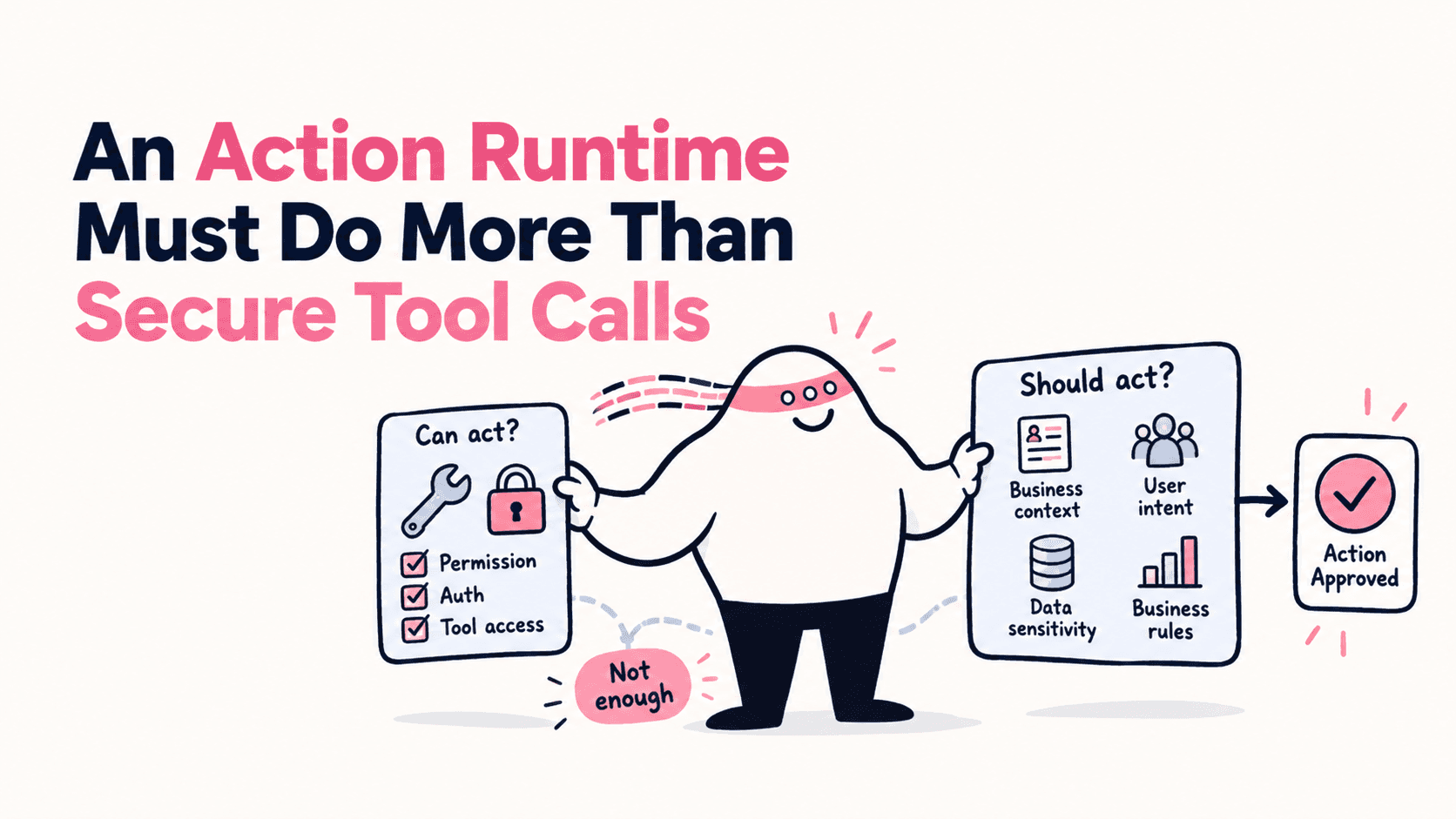
Security can determine who may act. Business autonomy requires knowing what should happen, on which evidence, through which process, and validating it before it takes effect.
The wrong payment can be perfectly authenticated. An unresolved incident can be closed by an agent with the right permissions. An order can ship through a secure API before the business conditions for shipping have been met.
None of these failures requires stolen credentials or a prompt injection. The agent can remain entirely inside its technical security boundary and still be wrong for the business.
That gap is not solved by permissions alone. It is the gap between technical authority and business authority.
Rippletide is built for that second boundary. It turns business sources into a maintained decision context that tells agents what information matters, which process applies, what conditions must hold, and whether a consequential action is legitimate before it takes effect.
Enforcing business logic is not the same as building the decision model behind it
Arcade is a useful example because it describes itself as an enterprise-ready actions runtime. It provides delegated authorization, governed tool execution, and contextual controls around actions.
Its Contextual Access model also lets customers connect external logic to validate, modify, or block a request before execution. That is valuable, but it exposes the missing layer: the runtime can enforce supplied logic, while the business still needs a maintained reference that determines which logic applies in the first place.
Where do the relevant conditions come from? Which data establishes them? Which process is active? Which exception applies? And are those facts still current when the action is about to become irreversible?
Enforcing business logic and constructing the business reference behind that logic are different responsibilities.
Rippletide starts with the business, not the tool call
Rippletide builds a versioned business decision reference from the company's existing sources, without creating a duplicate operational data store.
That reference, Rippletide's Decision Context, connects what the agent is trying to accomplish with the business objects involved, the data and evidence required, the applicable process, the current state, the legitimate transitions, the relevant policies and exceptions, and the conditions that must hold before a consequential action can take effect. Rippletide maintains this context as the business changes. When policies, procedures, or relevant facts change, the applicable context and resulting decisions can change with them, while provenance and versioning preserve why a decision was made.
A tool schema defines what an API accepts. A permission system defines who may invoke it. A policy hook can evaluate a condition supplied to it. None of those, by itself, establishes the operating context that makes the action legitimate.
Rippletide addresses the business question: in this exact situation, what must be true for the next process step or action to be legitimate?
The runtime verdict is therefore an output of a much larger chain:
Business sources → Decision Context → required data and applicable process → business decision → runtime validation → action.
That continuity is the point. A system that appears only at the final API call can stop a bad action, but it may be too late to help the agent follow the right process, gather the right evidence, and reach the right business outcome.
The same permission can support either the right action or the wrong one
Consider an illustrative incident-resolution agent with permission to restart a service, update the incident, and notify customers. Its credentials are valid, its tools are approved, and every API request can be technically valid.
Permissions can authorize the restart. They do not make it the right next step or establish that the incident should be closed.
Suppose the applicable operating procedure requires traffic to be redirected before the restart. Closure then requires the affected service and a downstream dependency to remain healthy for a defined observation period.
Those requirements span service topology, incident classification, runbooks, current traffic state, monitoring data, and change-management rules. The Decision Context connects those elements into something the agent can use while it works.
If traffic state is unknown, the agent does not need an approval. It needs the missing fact. Rippletide can identify that requirement so the agent can retrieve it and continue.
If traffic has not been redirected, the agent has an unmet process condition, not a dead end. If authorized, it can perform that step and continue.
After the restart, healthy service metrics may still be insufficient if a downstream dependency remains degraded. Rippletide can identify that unmet condition before closure and explain what still needs to be established.
Once the required evidence establishes recovery and the applicable conditions are satisfied, Rippletide determines that the closure conditions are met. The agent can then close the incident through the controlled execution path.
Autonomy increases because the operating requirements become usable by the agent throughout the work, while consequential actions remain controlled.
Explain what prevents progress so the agent can resolve it
A control that only returns "blocked" stops an agent. Rippletide is designed to return the business reason the agent needs to continue whenever the case is still resolvable. That same reason is what makes explainability governed rather than reconstructed after the fact, which is exactly what a regulator asks for when it wants to know why an action was allowed, refused, or delayed.
If a required fact is missing, Rippletide identifies what is needed and why it matters. If a proposed action violates an applicable rule, it identifies the condition so the agent can correct the proposal when a compliant path exists. If a different process applies, the agent can follow it instead of escalating because its first path was wrong.
This is how Rippletide increases autonomy: the agent gets the business decision, the reason behind it, and the information needed to progress toward a legitimate outcome.
Human escalation is the last resort, reserved for situations that truly require human authority or judgment, such as a discretionary exception, an unresolved conflict between authoritative rules, an uncovered case, or an explicitly required approval.
An incomplete case is not automatically a human case.
Validate again before the action becomes irreversible
A correct decision can become wrong before execution, so the action must be validated again before it takes effect. Take the incident-resolution agent again: CPU usage can move while the plan is being executed, and the remediation that was correct when it was decided becomes the wrong fix by the time it runs.
Indeed, a contract can change. An exception can expire. A payment can already have been made. Another agent or employee can complete the same operation while the first agent is still working. New evidence can make an earlier conclusion obsolete.
This is what makes Rippletide an Action Runtime.
Before each consequential action executes, Rippletide resolves it against the applicable Decision Context and the current relevant facts. It verifies that the proposed change is still legitimate and explains why when it is not.
This is where decision infrastructure becomes execution authority.
The distinction matters most for actions that are difficult or impossible to undo: releasing a payment, modifying production, committing inventory, closing an incident, changing an entitlement, or communicating a binding outcome to a customer.
Audit after the fact can explain what went wrong. Runtime validation is designed to stop the wrong action before the business has to live with the consequence.
Security answers: "Can this actor execute this action?"
Rippletide answers: "Should this action take effect now, in this process, with these facts and conditions?"
Enterprise autonomy requires both.
The gap exists across the agent stack
Tool platforms such as Composio can connect agents to business systems. Agent frameworks such as LangGraph can orchestrate steps and maintain state. Workflow engines can reliably execute long-running processes. Policy platforms such as Amazon Bedrock AgentCore Policy can evaluate explicit rules, while Workato can model deterministic business decisions.
These capabilities already cover substantial parts of the stack and, in some cases, business logic itself. The unresolved question is how the business becomes an explicit, maintained, runtime-usable reference: what data is required, which process applies, which transitions are legitimate, which policy or exception governs the case, and whether the proposed action remains valid at execution.
That is the layer Rippletide is building.
Rippletide complements permissions and security rather than replacing them. Security protects the execution boundary. Rippletide makes the business boundary explicit, usable by agents, and enforceable before an action takes effect.
From secure execution to business autonomy
More tools do not create enterprise autonomy. Neither does relaxing controls.
Autonomy comes from making the operating logic of the business explicit and usable: the required data, the applicable process, the decision conditions, and the boundaries within which an action can legitimately take effect. Then that same logic must be enforceable at runtime, before the action becomes irreversible.
That is the missing boundary between technical permission and business authority.
A secure action runtime establishes whether an actor is authorized to execute an action. An enterprise Action Runtime must also establish what should happen, why it is legitimate, and whether it is still legitimate at the moment it takes effect.
 Yann Bilien
 Patrick Joubert