AI Agent Control Towers Are Coming. The Action Boundary Is Still Missing.
 Patrick Joubert2026-06-25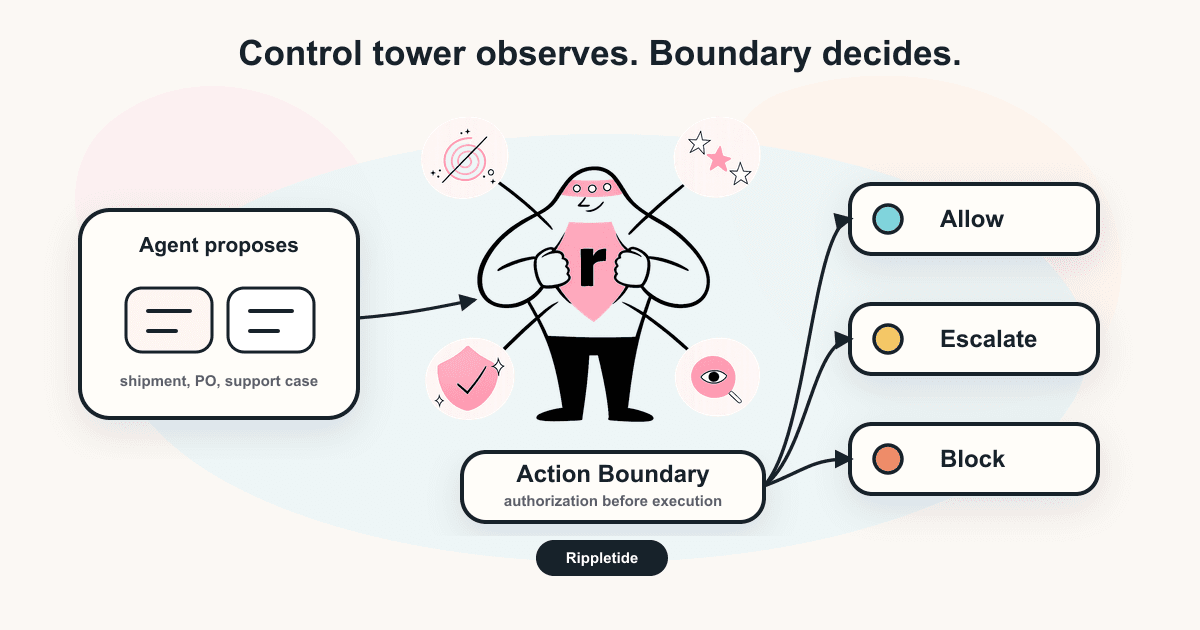
TL;DR: AI control towers are becoming the natural enterprise response to agent fleets. They help teams see agents, owners, systems, risks, and failures. But they do not answer the harder question before execution: is this agent allowed to take this specific action, in this specific business context, right now? That missing layer is the action boundary.
Enterprises are moving past the first wave of isolated AI agent experiments. The question is no longer only: can we build an agent? It is becoming: what happens when we have 20, 50, or 200 agents acting across Salesforce, ServiceNow, Zendesk, ERP, finance systems, support workflows, logistics operations, engineering tools, and customer operations?
The enterprise response is becoming clear: AI control towers. That makes sense. As agent fleets grow, companies will need a central place to see which agents exist, what they are connected to, who owns them, how they perform, where they fail, which risks they introduce, and which workflows they influence.
Control towers are necessary. They are not sufficient.
Agent fleets need a control tower
An AI control tower is the right answer to a real operating problem. Once agents move beyond demos, the company needs visibility, ownership, inventory, performance monitoring, access mapping, risk posture, operational incidents, and coordination across teams.
Without that view, agent programs fragment. One team ships an agent in a support workflow. Another connects a finance agent to an internal approval process. A third pilots a logistics agent against carrier data. Each agent may be useful, but the enterprise loses the shared map of what exists and where it can act.
That is why the control tower category will matter. It gives the enterprise a place to observe and manage the fleet.
But the hardest enterprise question is not only visibility. It is authorization.
Visibility is not authorization
Before an agent updates a CRM record, escalates a support case, changes a customer account, modifies payment terms, releases a purchase order, reroutes a shipment, or calls an external tool, the business needs to answer one precise question:
Is this agent allowed to take this action, in this business context, right now?
That question cannot be solved by a dashboard. A dashboard can show what happened. Monitoring can detect patterns. Audit logs can reconstruct events. Risk views can help teams prioritize. Incident response can help after something goes wrong.
None of that is the same as deciding, before execution, whether the action should cross the boundary into a real system.
This is the distinction enterprises need to make now. The AI control tower is the right layer for visibility, coordination, ownership, risk posture, and operational oversight. The action boundary is the right layer for pre-execution authorization.
The missing primitive is the action boundary
For every proposed agent action, the enterprise needs a clear answer:
- allow;
- escalate;
- block.
That answer must be based on business context, policy, permissions, evidence, exceptions, ownership, and traceability. It cannot be a prompt. It cannot be only a model's interpretation of a policy document. It cannot be a best-effort instruction hidden inside an agent configuration. It cannot be a workflow fork that breaks when the platform changes.
The action boundary has to live outside the model.
Models change. Prompts drift. Agents fork. Workflows evolve. Platforms add new capabilities. Backup models replace primary models. Teams build new agents faster than central teams can review them.
If authorization lives inside the model, it moves every time the model moves. If authorization lives inside one orchestration layer, it fragments every time a team adopts another platform. If authorization lives only in a dashboard, it arrives too late.
This is why pre-execution enforcement is becoming a core enterprise AI architecture question, not a nice-to-have governance feature.
A logistics example: rerouting a shipment is not just routing
Consider a logistics agent monitoring delayed shipments for strategic customers. The agent sees that a critical shipment will miss its delivery window unless it reroutes through a faster carrier and a different transit hub. Technically, the agent can propose the reroute. The control tower can show that the agent exists, which workflow it belongs to, which systems it is connected to, and whether similar reroutes have succeeded before.
But the business question is different: should this reroute execute automatically?
The answer may depend on the shipment category, customer contract, region, carrier approval status, cost threshold, delivery commitment, export-control constraint, and whether the shipment contains regulated components. A faster carrier may be operationally attractive but contractually invalid. A transit hub may be available but not approved for that customer. A cost increase may be acceptable for one account tier and require human approval for another.
The action boundary has to decide before the system changes the route:
- Is the carrier approved for this country and shipment category?
- Does the customer contract allow this service tier?
- Does the route cross a region with compliance constraints?
- Does the cost increase exceed the automatic-action threshold?
- Does this shipment require human approval because it contains regulated components?
The result is not a longer prompt. It is an executable decision: allow, escalate, or block, with the evidence recorded.
The boundary cannot live in the model
This is where many agent programs become fragile. Teams put policy text into prompts, add tool instructions, define narrow workflow branches, and rely on the model to interpret the rule correctly in context. That can work for a demo. It is not a durable control layer.
The model can propose. The system still needs a layer that decides whether the proposed action is authorized.
For enterprise agents, that layer needs to be portable across agents, workflows, platforms, and model providers. It also needs to be inspectable by business owners, risk teams, compliance teams, and production owners. Otherwise every model change, agent fork, or workflow migration becomes a new approval problem.
That is also why agent continuity is more than a backup model. As we wrote in A Backup Model Is Not an Agent Continuity Plan, availability does not preserve behavior when business logic is buried in prompts or workflow glue.
Control tower and Decision Runtime are different layers
This is where Rippletide fits.
Rippletide is not another monitoring dashboard. Rippletide sits at the action boundary. The agent proposes an action. Rippletide checks the business context, applicable rules, permissions, and evidence, then returns an executable decision: allow, escalate, or block.
The decision is recorded. The reason is explainable. The policy is externalized from the model. The boundary remains portable across agents, workflows, platforms, and model providers.
Control towers show what agents are doing. Rippletide decides what agents are allowed to do.
That distinction matters because AI agent governance will not be won only by better dashboards. It will be won by making action authorization explicit, portable, and enforceable before execution. It also has to be auditable, because production owners need evidence that the system followed the right boundary, not only a log that something happened afterward.
Read more on AI agent auditability and the agent decision infrastructure required to make this work in production.
Seven questions before scaling an agent fleet
Before scaling an agent fleet, enterprise teams should ask seven simple questions:
- What actions can our agents take?
- Which systems can those actions affect?
- Who owns each action boundary?
- What evidence is required before execution?
- Which actions must escalate to a human?
- Which actions must always stay blocked?
- Where is the decision recorded?
If those answers are unclear, the enterprise does not yet control its agents. It only observes them.
Start with the boundary
Control towers are a good category. Enterprises will need them as agent fleets expand. But the hard decision lives one layer deeper.
The control tower helps the enterprise see and manage the fleet. The action boundary decides whether an agent is allowed to act.
If you are preparing to scale agentic workflows, start by mapping the action boundaries before adding another dashboard.
Take the AI Agent Production Readiness Test
Further reading
Frequently Asked Questions
An AI agent control tower is an enterprise oversight layer for agent fleets. It helps teams see which agents exist, which systems they touch, who owns them, how they perform, and where operational risks appear.
A control tower improves visibility and coordination, but visibility is not authorization. Enterprises still need a pre-execution layer that decides whether a proposed action is allowed, must escalate, or must stay blocked.
An action boundary defines what an AI agent may do, what must escalate to a human, and what must never execute, based on business context, policies, permissions, evidence, exceptions, and audit requirements.
Authorization should live outside the model and outside a single orchestration layer, so it remains portable across agents, workflows, platforms, and model providers.
 Patrick Joubert
 Yann Bilien