All conditions met
Continue- Service
- Restored
- Affected accounts
- Access confirmed for all
- Promised follow-up
- Sent
All required conditions are met. The agent can close the ticket without another manual review.
Let agents complete more work under your business rules. Rippletide checks proposed actions against your business context, current facts, and rules. Valid actions move forward. Exceptions reach the right person. Every decision is explained.










One support ticket. Two possible decisions.
Keep your team for the exceptions.
Your support agent is ready to close a ticket. The service is back online. But are all affected customer accounts working again? Has the promised follow-up been sent?
Rippletide checks the proposed closure against the service report, customer account records, and support history, using the conditions your team defines.
Close the ticket only when every affected account is restored and the promised follow-up is complete.
Illustrative scenario, not a customer result.
All required conditions are met. The agent can close the ticket without another manual review.
Keep the ticket open. Your team knows exactly what to check: confirm access for the remaining account.
Same action. Same business rule. Different evidence. Every decision keeps its reason and evidence references.
Turn business knowledge into rules your team approves. Apply those rules to current facts, validate the proposed action, and explain the decision before it takes effect.
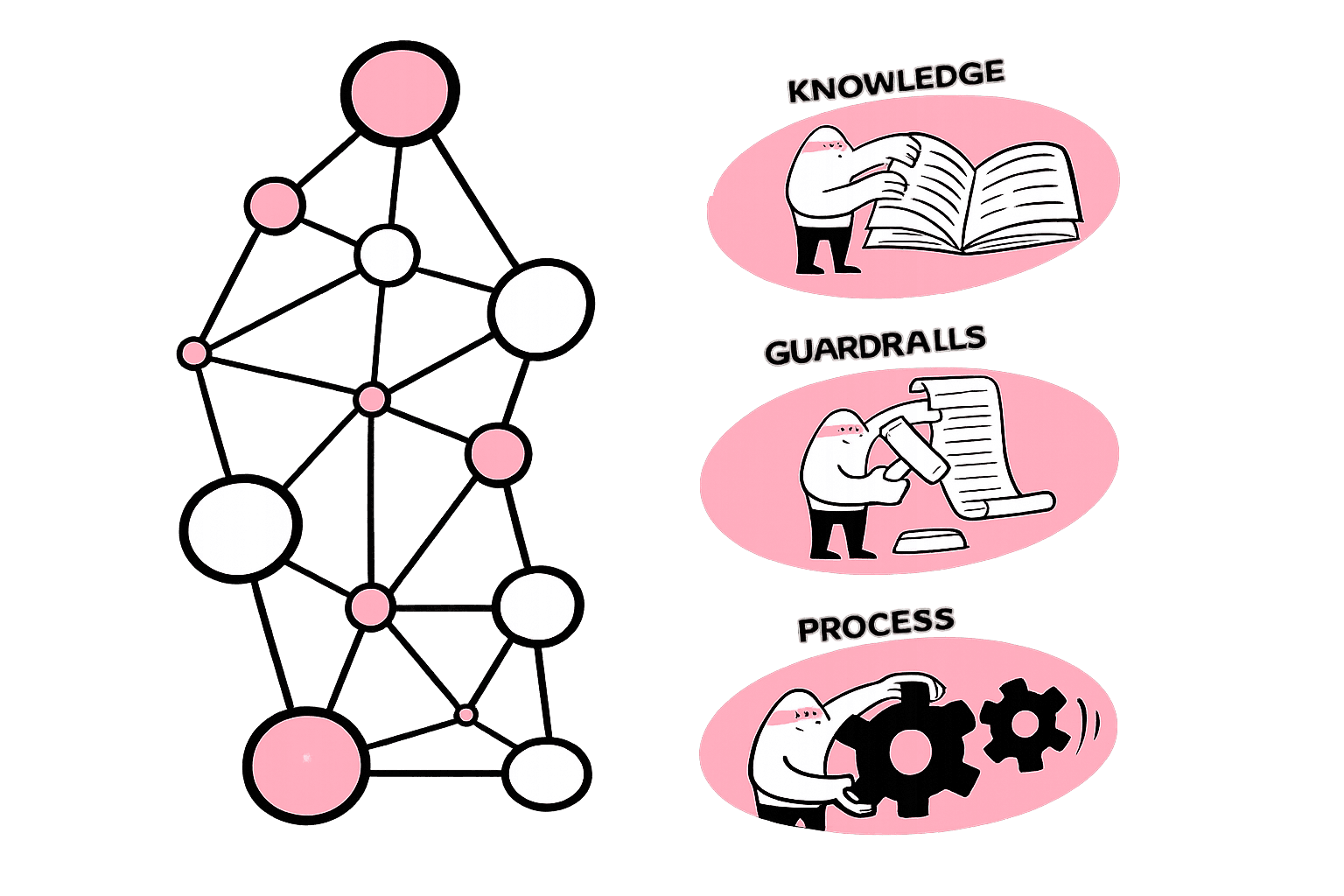
Your business defines the rules. Rippletide applies them when agents act.
Identity tells you who can act. Rippletide tells you whether this specific action has enough business evidence to execute.
Choose one action that still creates a human queue: closing an incident, changing an account, or approving an exception. Rippletide checks the facts and business conditions before the action reaches a business system, so complete cases can move forward and unclear or risky cases reach the right person.
An ITSM agent proposes closing a Sev-2 incident and updating the customer status page. In this scenario preview, Rippletide checks the runbook, incident severity, affected customers, owner approval, and status-page policy.
{
  "decision": "APPROVAL_REQUIRED",
  "reason": "Customer-facing status changes require incident commander approval.",
  "evidence": ["Sev-2 confirmed", "Runbook matched"],
  "missing_evidence": ["incident_commander_approval"],
  "trace_id": "tr_123"
}
The agent is not blocked from working. Only the risky write-action is flagged until the right evidence and approval are captured.
Business conditions met. The agent can proceed.
In this illustrative scenario, the incident commander approves the update. Rippletide checks the updated facts against the business rules. With all required conditions met, the agent can update the customer status page. The decision and supporting evidence are recorded.
Security Review Dossier
A homegrown approval layer is self-attested. Rippletide gives agent companies and enterprise teams a reusable, review-ready dossier showing how high-risk write-actions are detected, tested, approved, and traced.
EU data residency available. No training on customer data. SOC 2 audit in progress.
Rippletide reviews the tool surface your agents already expose, whatever the framework underneath.
Start with a review of your agent's tool manifest. Build the first Safety Case. Activate runtime enforcement when it is proven.
Also available for Claude Code rule enforcement as a developer proof surface.
Rippletide started as deep research: a hypergraph decision database, automatic ontologies, and neuro-symbolic reasoning for agent decisions. That research now runs underneath every risk review, Safety Case, and decision preview.
Automatic Ontologies and the Context Graph for agents are where that work lives. All of it is gathered on the research hub.
Everything you need to know about write-action safety. Can't find your answer? Talk to our team
Rippletide is the Action Runtime for AI agents. It checks proposed actions against explicit business rules and current facts, then returns a decision with its reason and supporting evidence.
Rippletide is built for teams deploying support, ITSM, and revenue agents that need to act inside Zendesk, Stripe, ServiceNow, Salesforce, or internal APIs.
It evaluates one important action using agreed cases and frozen criteria. It shows what can proceed, what needs a person, and what must stop, without changing production.
If the action is READY, production activation for that same action is scoped separately. If it is NOT READY, the result identifies the precise remaining gap.
A decision preview shows how a specific write-action would be cleared, held for approval, or blocked in a tested scenario. It includes the evidence present, what is missing, the reason, and a trace before runtime enforcement is activated.
IAM controls who can call a tool. Governance platforms provide broad oversight. Tool connectors provide access. Rippletide reviews whether one specific high-risk write-action has enough business evidence and approval to be enabled safely.
The free risk review does not. We start from the agent's tool manifests, MCP exports, OpenAPI schemas, or JSON definitions. Production activation is scoped separately.
You can code individual checks. The ongoing work is keeping them aligned with changing business policies, testing updates, and explaining decisions. Rippletide brings rule review, validation, and decision evidence together.
Review your tools, find your riskiest write-action, and turn it into a Safety Case your enterprise customer can review.