Llama 3: Enhancing AI Accessibility
 Yann Bilien2024-05-15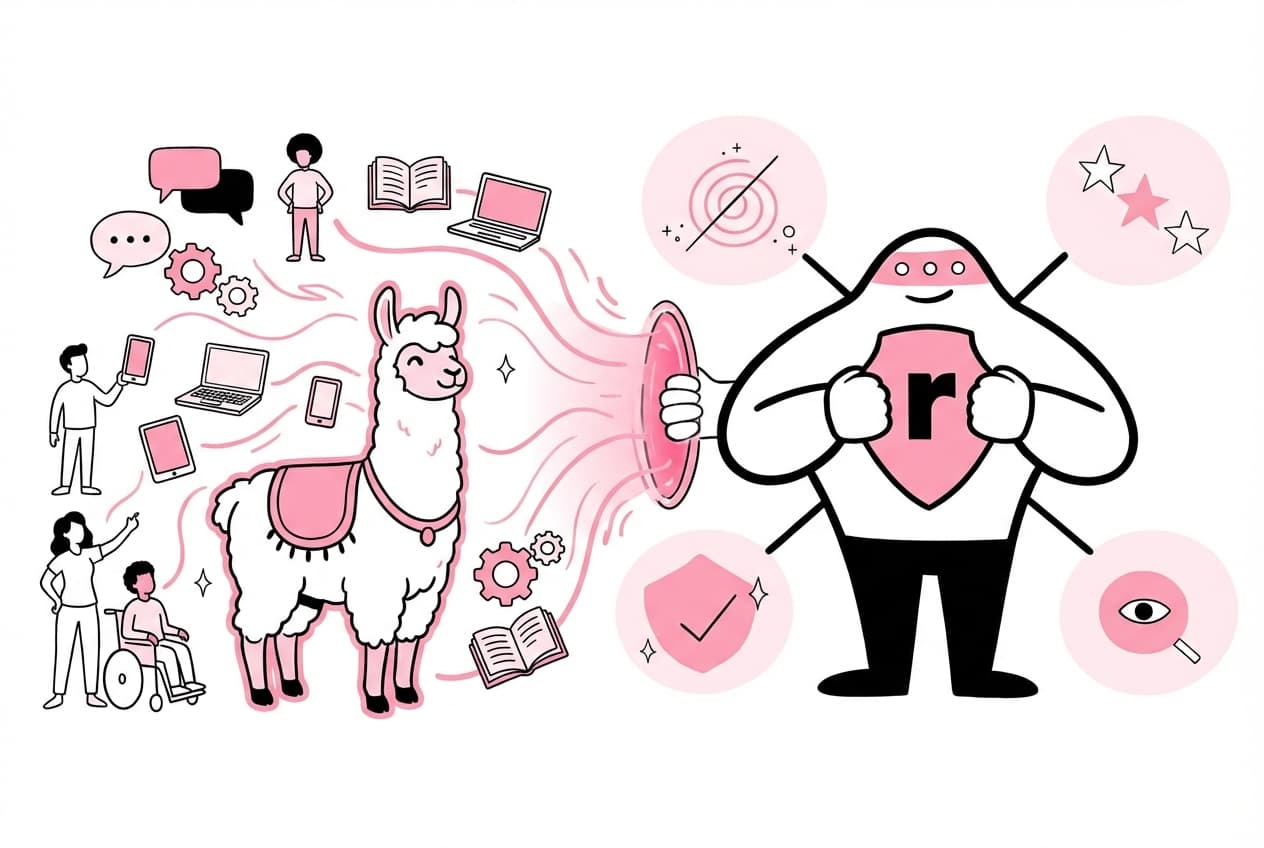
Meta's release of Llama 3 marks a significant step forward for open-source AI. The model delivers performance competitive with leading proprietary systems while remaining freely available for commercial use. For enterprises building AI agents, this changes the calculus on model selection, deployment flexibility, and long-term vendor independence. But it also sharpens a question that the industry has been slow to address: what sits on top of the model?
What Llama 3 Delivers
Llama 3 arrives in multiple parameter sizes, with the largest variants matching or exceeding GPT-class models on standard benchmarks. The improvements are meaningful: better instruction following, stronger reasoning on multi-step tasks, and reduced hallucination rates compared to Llama 2. For enterprise teams, the practical impact is an open model that handles complex workflows without the quality compromises that previously made open-source a secondary option.
The licensing is equally important. Llama 3 allows commercial deployment, fine-tuning, and integration without the restrictions that limit many alternatives. Enterprises can run it on their own infrastructure, keeping sensitive data within their security perimeter.
The Open-Source Momentum
Llama 3 is not an isolated event. It is part of an accelerating trend toward open-source AI that is reshaping the competitive landscape. Mistral, Falcon, and other open models have demonstrated that cutting-edge performance does not require proprietary lock-in. Each release narrows the gap between open and closed systems, giving enterprises genuine choice in how they build their AI stacks.
This momentum matters because it shifts power from model providers to infrastructure builders. When the model layer becomes commoditized, the differentiation moves to what surrounds it: the reasoning layer, the verification layer, the orchestration layer.
Where Open Models Meet Structured Reasoning
A powerful open model is a necessary but insufficient component of an enterprise AI agent. Llama 3 can generate fluent, contextually appropriate responses. It cannot, on its own, enforce business rules, verify compliance constraints, or produce deterministic audit trails. These capabilities require a structured reasoning layer that operates independently of the model.
This is where Rippletide's architecture becomes relevant. Our hypergraph-based decision database works with any underlying language model, open or proprietary. It provides the verification and reasoning layer that transforms a capable model into a trustworthy agent. Llama 3 makes the model layer more accessible. Rippletide makes the reasoning layer enterprise-grade.
What This Means for Enterprises
The combination of high-quality open models and structured reasoning infrastructure gives enterprises a deployment path that was not available even a year ago. They can run Llama 3 on premises for data sovereignty, layer Rippletide's decision engine on top for safety and compliance, and maintain full control over their AI stack without depending on any single vendor.
Llama 3 is a milestone for AI accessibility. The next milestone is making that accessible intelligence reliable enough for production. That is the work Rippletide is doing.
Frequently Asked Questions
Llama 3 delivers GPT-class performance as an open-source model with commercial licensing. Enterprises can run it on their own infrastructure, keeping sensitive data within their security perimeter. But the model alone is insufficient — production AI agents need structured reasoning infrastructure on top.
Open-source models like Llama 3 offer deployment flexibility, vendor independence, and data security. The gap between open and closed models is narrowing with each release. The critical differentiator is not the model but the reasoning infrastructure built on top of it.
Llama 3 allows commercial deployment, fine-tuning, and integration without restrictions. Enterprises gain genuine choice in their AI stack and avoid proprietary lock-in — a trend accelerated by Mistral, Falcon, and other open models.
 Yann Bilien
 Thomas Molinier
 Patrick Joubert