Autonomous Agents Need Authority
 Patrick Joubert2026-02-17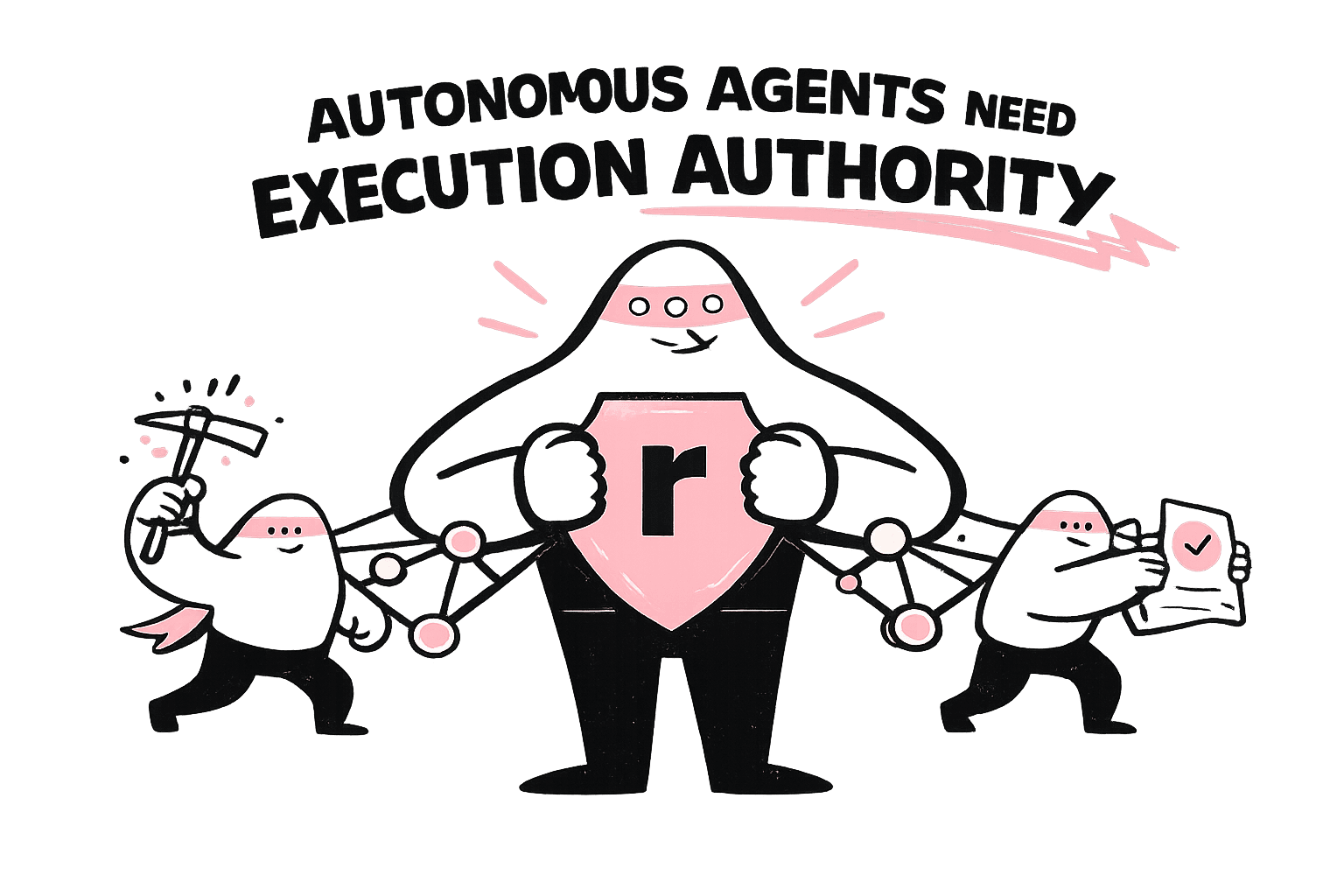
Intelligence Without Execution Control Is Not Infrastructure
Software just crossed a threshold. For the first time, we are deploying systems that can independently decide and execute actions in production. Not scripts. Not workflows. Not deterministic automation. Autonomous agents. They reason. They plan. They choose. They act. And we are shipping them into real systems, financial, operational, customer-facing , without a formal execution authority layer. That is a structural gap. And structural gaps do not remain open for long.
The Industry Is Optimising the Wrong Layer
The AI ecosystem is currently obsessed with intelligence. Better models. Longer context windows. More tools. More reasoning loops. Higher eval scores. But intelligence is only one component of an autonomous system. An agent that can think is not the same as an agent that can decide and execute what is authorised. . Right now, most production agent stacks look like this:
LLM → Tool → Production
The model generates intent. The tool executes it. If the LLM proposes the action, the system runs it. There is no deterministic authority in between. That is not a mature architecture. It is optimism and very risky behavior.
Intelligence Is Probabilistic. Execution Is Irreversible.
LLMs are stochastic systems. They generate likely continuations given context. They do not provide deterministic guarantees. Yet we allow them to trigger:
- Financial transfers
- Database mutations
- Workflow approvals
- API calls with side effects
- Operational decisions
In many cases, these actions are irreversible. Or even a simpler PA agent: would you accept 1 out of 5 meetings booked in the wrong slot? When a model upgrade changes behaviour, when a prompt tweak shifts reasoning paths, when a context boundary subtly alters decision flow , the execution still happens. After the fact, we may have logs. We may have traces. We may have dashboards. But we do not have authority. Most of the time it is too late. Explanation is not prevention.
Every Era of Computing Introduced an Authority Layer
This pattern is not new. Databases introduced transaction managers because writes are dangerous. Operating systems introduced kernel mode because memory is dangerous. Browsers introduced the same-origin policy because scripts are dangerous. Networks introduced firewalls because packets are dangerous. Distributed systems introduced consensus because coordination is dangerous. Whenever software gained autonomy over something consequential, a layer emerged that controlled whether actions were allowed. Autonomous agents are no different. The action capability even worsen the menace. We are currently deploying intelligence without formal execution authority. That will not last.
The Missing Layer: Authority Between Intent and Action
The future stack for autonomous systems is not complicated. It is simply incomplete today.
Intelligence → Authority → Execution
The LLM generates intent. An authority layer determines whether that intent is allowed to become action. Execution only occurs if authorised. Without authority, autonomy is fragile.
What Authority Actually Means
Authority is not monitoring. Authority is not logging. Authority is not an eval score. Authority means:
- Decision logic externalised from prompts
- Structured, enforceable constraints
- Stateful decision memory
- Runtime validation before execution
- Deterministic replay across runs and model versions
- Blocking capability at the execution boundary
The key property is simple: An action does not execute unless it is authorised. This sounds obvious. It is not how most agents operate today.
The Illusion of Control
Many teams believe they have control because they have:
- Prompt guardrails
- Tool schemas
- Synthetic evals
- Observability pipelines
These are important. They are not authority. If execution control lives inside a prompt, it is not enforceable. If your enforcement depends on the model following instructions, it is not deterministic. Current performance level of 95% enforcement rate leads to only 60% correct enforcement in a 10-step workflow based on compounding errors. If you can only explain a failure after it happens, you do not control execution. You audit it. Autonomous systems cannot rely on cooperative intelligence. They require enforceable boundaries.
Model Progress Makes the Problem Worse
As models improve, agents become more capable. They chain tools more confidently. They generalise beyond narrow workflows. They take initiative. Autonomy compounds. And as autonomy increases, the surface area of irreversible execution increases with it. The more powerful the intelligence layer becomes, the more critical the authority layer becomes. This is not a safety argument. It is an infrastructure argument.
Reproducibility Is the Hidden Constraint
In production systems, reproducibility matters. If a customer challenges a decision. If a regulator requests explanation. If a model upgrade changes behaviour. If a workflow fails silently. You must be able to:
- Reconstruct the decision state
- Replay the reasoning deterministically
- Explain why action A was authorised and B was not
Without a structured, stateful authority layer, this is not possible. Logs do not provide determinism. Probabilistic reasoning cannot guarantee parity across runs. Authority requires structure.
This Is an Infrastructure Moment
When a new paradigm emerges, the first wave focuses on capability. The second wave focuses on control. Agents are currently in the capability phase. The control phase is inevitable. The companies that define the authority layer will define how autonomy becomes production-grade. Not by improving intelligence. But by governing execution.
Rippletide's Thesis
At Rippletide, we are building the authority layer for autonomous agents. We do not improve the model. We do not wrap prompts. We do not monitor after the fact. We sit at the execution boundary. The LLM proposes intent. Rippletide validates, enforces, or blocks. Execution happens only if authorised. Decision logic is externalised. Constraints are structured. State is persistent. Replay is deterministic. Authority is enforceable. Autonomous systems require infrastructure. Infrastructure requires authority. The era of intelligence-only agents is temporary. The era of enforceable autonomous systems is beginning.
For a deeper analysis of why context layers need a decision enforcement layer, read Context without enforcement is not infrastructure.
Frequently Asked Questions
Because LLMs are probabilistic systems that generate likely continuations, not deterministic guarantees. Without a formal authority layer between intent and action, agents can trigger irreversible operations (financial transfers, database mutations, workflow approvals) based on stochastic reasoning alone.
Monitoring and logging explain failures after they happen. Execution authority prevents unauthorized actions before they execute. Authority means decision logic is externalized from prompts, constraints are structured, and actions are blocked at the execution boundary if not authorized.
A 95% enforcement rate in prompts compounds to only 60% correct enforcement in a 10-step workflow. If enforcement depends on the model following instructions, it is not deterministic. Autonomous systems require enforceable boundaries, not cooperative intelligence.
Rippletide sits at the execution boundary. The LLM proposes intent, Rippletide validates, enforces, or blocks. Execution happens only if authorized. Decision logic is externalized, constraints are structured, state is persistent, and replay is deterministic.
 Yann Bilien
 Thomas Molinier
 Patrick Joubert