Context Graphs: What They Actually Solve?
 Yann Bilien2026-01-27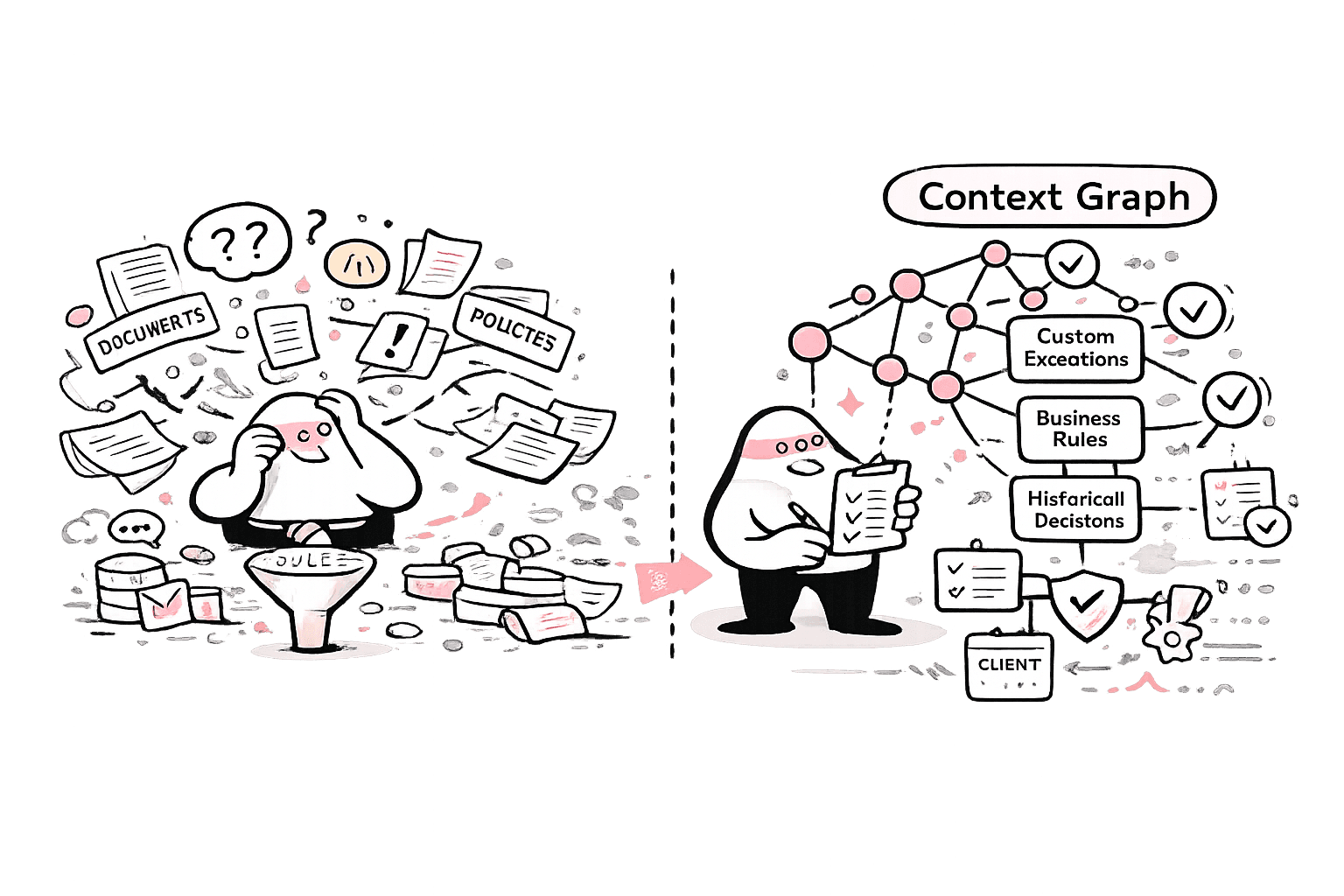
and Why AI Agents Need Them?
Many AI Agents' unreliability stems from context challenges. It can be hallucinations because the Agent doesn't have access to the correct information, a guardrail not followed as it wasn't visible to the Agent, a wrong decision because data provided are incoherent or contradictory.
Those are context failures: the agent had access to information, but no reliable way to determine whether that information was applicable, valid, or allowed for the action it was about to take.
This problem becomes visible the moment AI systems move from answering questions to taking actions. As error compounds, a 5% error rate becomes 40% in a 10-step workflow. The same infrastructure used for a RAG-based LLM chatbot doesn't work for an Agent.
The real problem: context without constraints
In modern systems, context is everywhere.
It lives in:
- CRMs
- ticketing systems
- policy documents
- product catalogs
- logs
- databases
- embeddings and vector stores
All of this provides information, very little of it provides applicability.
When a human makes a decision, they implicitly filter context:
"This policy doesn't apply to enterprise customers."
"That exception expired last quarter."
"We've overridden this rule before, but only for renewals."
"This contract clause applies only in the EU."
Humans carry this filtering logic in their heads.
AI agents do not.
Why this breaks as soon as agents act
The traditional way to build an LLM-based application such as a chatbot is the following:
Prompt an LLM in a loop to achieve an objective, provide some tools to achieve the objective and provide context to the LLM using a retrieval method (RAG, GraphRAG etc).
The agent doesn't have a clear workflow to execute so it has to make decisions. Should I call tool A or tool B? Should I send an email or call the prospect? Should I assign the Jira ticket to IC A or IC B?
To make those defining decisions, the only help given to the LLM is what's usually called "context". Most genAI systems today rely on some form of context retrieval:
- keyword search
- SQL queries
- RAG pipelines
- Embeddings
But what's this context? Most of the time cold data such as Salesforce fields, a policy, a user buying history or just some text related in a way or another to the objective.
And there's the rub:
1- The data found is not necessarily the one needed to make the decision,
90% of the time the LLM will still answer something, as the data was missing with a very high chance of inventing a fact, saying something false or unjustified (hallucinations)
2- There's no guide toward the decision
Even with the right data point how to make the decision?
E.g. the context provided is a Jira ticket, the LLM still has to choose to assign it IC A or IC B
What lacks here is either (a) a guidance to make the decision with a rational behind or (b) a system that makes the decision instead of the LLM.
Retrieval is not decision context
RAG is often described as "giving the model context.", in reality RAG gives the model documents, not decision context.
A retrieved document does not tell you:
- whether it applies,
- whether it is superseded,
- whether it conflicts with another rule,
- or whether it was already overridden in similar cases.
As a result, agents often combine incompatible rules, apply outdated policies, or invent constraints to fill gaps.
At scale, the question isn't will it happen but when will it happen.
What a Context Graph actually is
A Context Graph is a structured system that represents:
- business entities (customers, contracts, products, roles),
- rules and policies,
- exceptions and their scope and validity over time,
- Decision traces on how to move from a state to the next one
The latter is key: traditional systems of records store states. For example, in Salesforce the different state of the lead. What is not stored is actually how the lead moved from a prospect to a qualified lead. What happened? Which decisions? Which actions? As we've seen acting agents need to make decisions, to help them do that context graphs encompass the decision traces of the past.
It is optimized for one question:
"Given this situation, which context is applicable right now?"
The key distinction is simple but fundamental:
A Context Graph encodes applicability, not just relationships.
Relationships are not enough
Traditional data models answer questions like:
"Which contract belongs to which customer?"
"Which policy references which product?"
"Which ticket is linked to which account?"
These relationships are static.
Decision-making is not.
Applicability depends on who is acting, what action is proposed, when the action occurs, under which constraints, and which exceptions exist.
A Context Graph makes these dimensions explicit.
Temporal validity is not optional
One of the most common sources of agent failure is time.
We've seen in real enterprise contexts: policies change, contracts expire and exceptions are temporary.
Yet most systems treat context as timeless.
A Context Graph treats time as a first-class dimension: rules have effective dates, exceptions have scopes and expirations, decisions are anchored to the context that existed at the time they were made.
Without this, reproducibility is impossible.
Why agents specifically need this layer
Static systems can tolerate ambiguity as humans can compensate.
With an autonomous agent, by definition there is no more human to compensate.
Without a Context Graph:
- agents rely on probabilistic reasoning over unbounded inputs,
- behavior changes subtly as data evolves,
- errors are hard to reproduce,
- and explanations are post-hoc at best.
With a Context Graph: agents operate within explicit constraints, behavior is deterministic given the same inputs, and decisions are auditable.
It is about building predictable systems.
The Rippletide approach
Rippletide's Context Graph is deliberately narrow in scope.
It focuses on three principles:
1. Applicability
Context is returned only if it applies to the situation. No global context dumps. No "the model will figure it out."
2. Temporal validity
Every rule, exception, and decision is time-scoped.
The system knows not just what is true, but when it was true.
3. Traceability
For every piece of context included or excluded, the system can explain why.
This makes decisions:
- auditable,
- debuggable,
- and defensible.
That's it.
Context Graphs as infrastructure
As AI agents move into production systems, organizations need a way to: qualify context, constrain behavior, and explain outcomes.
Context Graphs are emerging as the simplest structure that fills that gap. But context alone is not enough: context without enforcement is not infrastructure.
Read more here regarding the Market Shift Around the $1T Context Opportunity
For a broader perspective on Context Graphs, explore thecontextgraph.co.
For a concrete example of how this infrastructure is being validated by the ecosystem, read our F/AI Deal Day recap.
Frequently Asked Questions
A context graph is a structured system that represents business entities, rules, policies, exceptions with temporal scope, and decision traces. It answers one key question: given this situation, which context is applicable right now? Unlike RAG which retrieves documents, a context graph encodes applicability.
RAG gives the model documents, not decision context. A retrieved document doesn't tell you whether it applies, whether it's superseded, whether it conflicts with another rule, or whether it was already overridden. Context graphs encode applicability, temporal validity, and traceability.
A 5% error rate compounds to 40% in a 10-step workflow. Without context graphs, agents rely on probabilistic reasoning over unbounded inputs, behavior changes as data evolves, errors are hard to reproduce, and explanations are post-hoc at best.
Applicability (context returned only if it applies to the situation), temporal validity (every rule and exception is time-scoped), and traceability (for every piece of context included or excluded, the system explains why).
 Thomas Molinier
 Patrick Joubert
 Yann Bilien