The Market Shift Around the $1T Context Opportunity
 Yann Bilien2026-01-22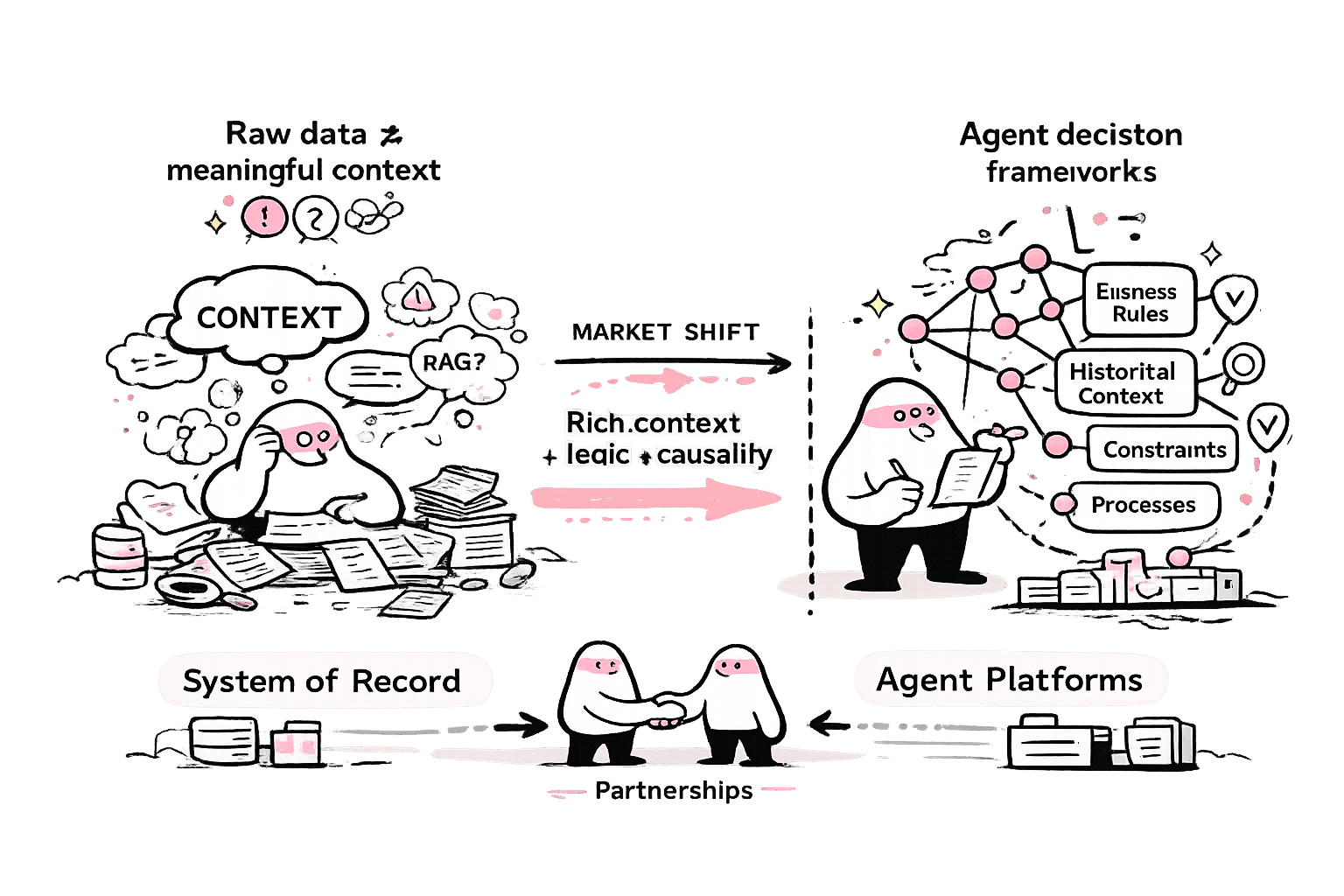
In 2026, agentic experimentations are ending and the focus shifts to business cases with production at scale. Many recent articles describe context graphs as a trillion-dollar opportunity, positioned as the missing layer to make those business cases deliverable. See here
This idea is becoming increasingly accepted. This will shift the market, opening a year of marriages of convenience
2024 - 2025: Context Becomes the Hard Problem
It is now easy and fast to deploy agent POCs and demos. Plug in a RAG pipeline, expose a few tools, and the agent appears to "have context." This assumption has driven most agent experimentation over the past two years.
These two discovery years proved something critical: context is not a synonym for recorded data. See more in Context Graphs: What They Actually Solve.
By definition, an agent takes an objective and decides how to achieve it. Decision-making is new territory for enterprise AI systems, and it introduces failure modes that traditional AI never had to handle.
When an agent is given inconsistent data, incomplete process definitions, or conflicting signals, it does not raise a flag. LLM-based agents tend to sweep complexity under the rug at the expense of reliability. The result is hallucinations and unpredictable behaviors, but above all what I call the "2025 illusion": coherent-looking yet incorrect behavior.
This is why representative agent evaluations are hard to conduct.
Context must therefore do more than inform an agent. It must teach the agent how to decide: what it is allowed to do, what it must not do, when to follow a process strictly, when to adapt, when to rely on past execution traces, and when, if ever, it is acceptable to invent.
Context must encompass the decision framework for the agent. It can be understood this way: agents aim to do people's jobs. Without a decision framework, it is like hiring a junior employee and giving them Salesforce access, and then what? They do not know what to do, nor the company's way of handling new leads, the criteria for distinguishing low- and high-value leads, or how to qualify them.
Since companies are building agents rather than hiring multi-year experienced professionals who have already proven effective, this decision framework must be defined and continuously evolved, in an enterprise setting.
Systems of Record miss part of the data (causality)
Systems of record (CRM, ERP, ATS, ticketing systems) were never designed to explain why things happened. They were designed to store what happened.
Take Salesforce.
You can observe that a deal moved from stage B to stage C. You can see the timestamp, owner, amount, and forecast category.
What you cannot see is:
Which signal triggered the change
Which conversation shifted the buyer's position
Which objection was resolved
Which internal decision was made and why
That information either never enters the system or is flattened into free-text fields that are not operationally usable.
As a result, systems of record expose state transitions without decision traces. They record outcomes, not the mechanisms that produced them.
An agent reasoning on top of this data is forced to infer causality from incomplete evidence. That is guesswork. As a result, systems of record provide data sources and agent user interfaces, but they lack the core infrastructure required to make agents trustworthy and reliable in production.
Infrastructure providers are too far from business processes
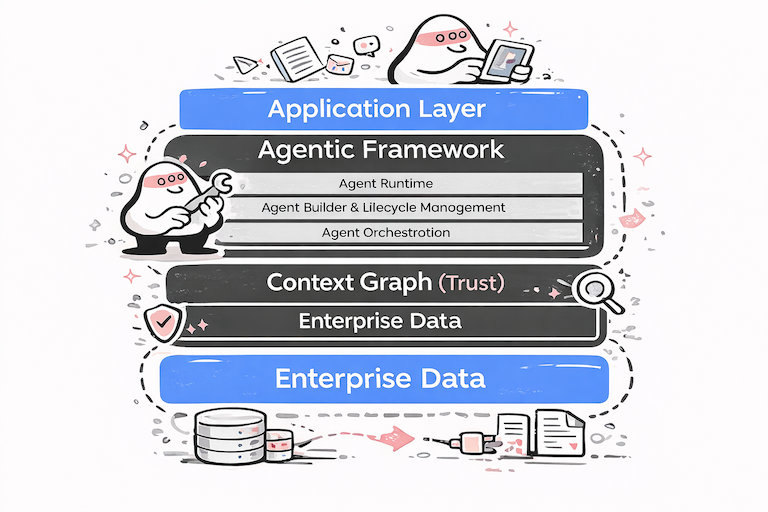
On the other side, agent infrastructure providers have solved a different problem: the execution layer.
Scalable agent runtimes are rapidly commoditizing. These capabilities are becoming table stakes, necessary to participate in the agent market, but insufficient to differentiate or capture durable value.
Agents are not traditional AI systems. They operate inside live business processes, where decisions are contingent, contextual, and path-dependent. The correctness of an action depends less on raw intelligence than on alignment with how the business truly operates.
This is why proximity to business processes matters.
This is why platforms like Palantir invested so heavily in embedding themselves close to operational processes rather than remaining at the infrastructure layer.
Hyperscalers and generic agent platforms struggle here by construction. Their position in the stack keeps them abstracted away from domain-specific decision logic. Without deep, continuous coupling to business processes, agents remain generic executors. They can follow instructions, but they cannot make complete and objective decisions.
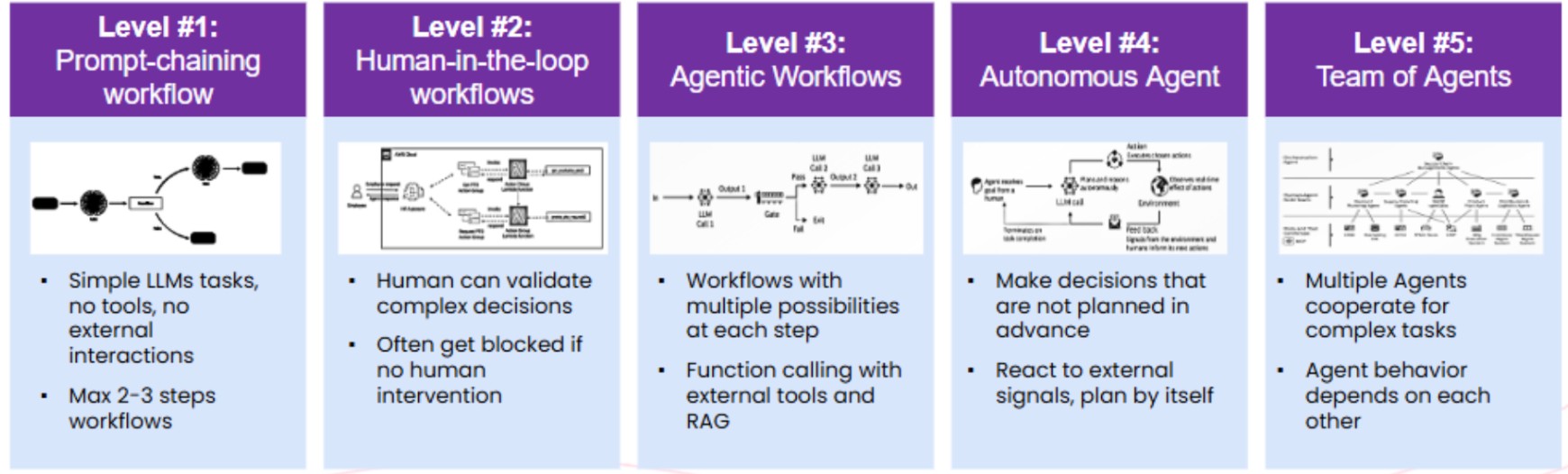
As a consequence, most of these systems remain at maturity levels 1-2-3 and never reach autonomous production systems, which is what is required to deliver business cases at scale.
2026: A year of marriages of convenience
I predict that 2026 will be a convergence year between systems of record and agent powerhouses. The market will see numerous partnerships, integrations, and acquisitions.
Over the past two years, both evolved in parallel. Systems of record accumulated authority, compliance, and historical state. Agent platforms pushed reasoning, execution, and scale forward. Each side progressed independently, and each hit a hard limit. Agents without systems of record lack legitimacy and grounding. Systems of record without agents remain passive archives.
Now, most enterprises are reaching the end of the experimentation phase and are seeking real business cases at scale, along with a unified offering to deliver them.
I believe hyperscalers will integrate external solutions to get closer to customers' data, particularly business processes. At the same time, systems of record will seek partnerships with agent infrastructure providers.
Frequently Asked Questions
Context graphs are positioned as the missing infrastructure layer to move AI agents from experimentation to production at scale. They encode not just data but the decision framework agents need: what they are allowed to do, when to adapt, and when to rely on past execution traces.
Systems of record (CRM, ERP, ATS) store what happened but never explain why. They expose state transitions without decision traces — an agent reasoning on this data is forced to infer causality from incomplete evidence, which is guesswork.
Agent infrastructure providers solved execution but remain abstracted from domain-specific decision logic. Without deep coupling to business processes, agents remain generic executors that can follow instructions but cannot make complete, objective decisions.
2026 will be a convergence year with partnerships, integrations, and acquisitions between systems of record and agent platforms. Hyperscalers will integrate external solutions to get closer to business processes, while systems of record will partner with agent infrastructure providers.
 Patrick Joubert